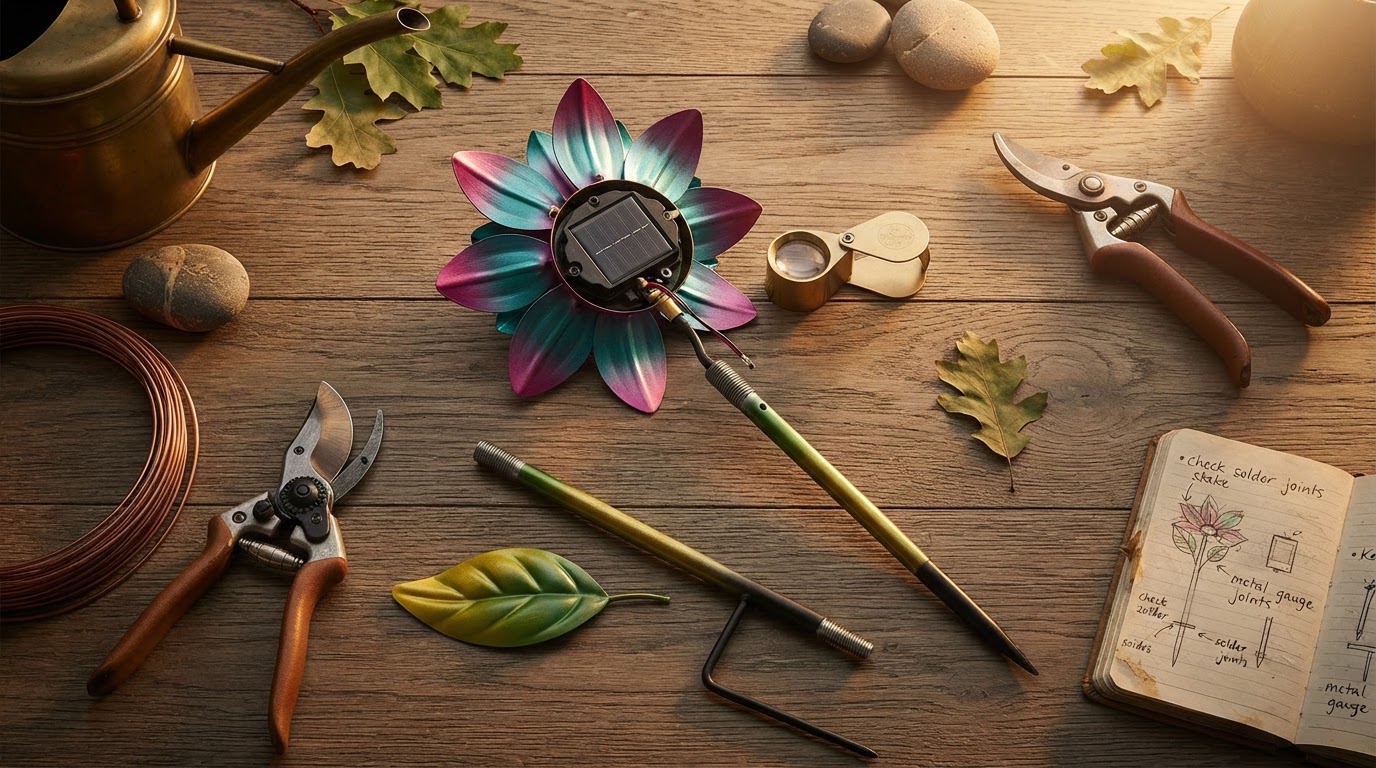
Selecting Solar Windmill Stakes for Kinetic Yard Art
 Maya ChenContributing Editor
August 23, 2026. This evaluation identifies the critical mechanical and electrical failure points in solar windmill stakes to assist homeowners in selecting durable garden hardware. It is written for consumers who prioritize structural longevity over temporary aesthetic trends.
The Mechanical Fragility of Decorative Yard Art
The conventional wisdom says that garden ornaments are purely aesthetic additions that require little more than a patch of soil and direct sunlight. However, the intersection of kinetic motion and solar energy collection creates a specific set of engineering challenges that most consumers ignore until the hardware fails. In high-wind environments, the rotational friction of a windmill head places significant stress on the central stake, often leading to metal fatigue or snapping at the joints. Reddit discussions regarding a light up windmill for yard frequently highlight that cheap plastic components degrade under UV exposure within a single season, rendering the decorative aspect useless. Furthermore, the integration of light into a moving part introduces wiring vulnerabilities. Unlike stationary lights, how do solar powered windmill lights work depends on a stable connection between the solar cell and the LED, which is often compromised by the vibration of the blades. Most manufacturers prioritize the visual appeal of a metal windmill garden stake solar lights assembly without calculating the weight-to-torque ratio required for sustainable movement. This oversight results in a product that either fails to spin in light breezes or becomes a projectile in heavy storms. The physics of wind resistance suggests that a larger surface area on the blades requires a significantly deeper anchoring system than the standard 6-inch prong found on most budget models. Without a reinforced base, the entire structure tilts, misaligning the solar panel and reducing energy capture efficiency by up to 40% based on basic geometry of incidence angles.
Structural Integrity and Kinetic Efficiency

Photo by Jorge Luis Acasiete Conza on Pexels
Here’s the part nobody talks about: the efficiency of solar windmill stakes is dictated by the quality of the bearings and the placement of the photovoltaic cell, not the number of LEDs. When evaluating a metal solar windmill for yard, the focus must shift from the paint finish to the gauge of the steel and the weatherproofing of the battery compartment. Solar powered kinetic wind spinner designs often fail because the solar panel is fixed to the rotating head, causing intermittent charging as the unit spins out of the direct path of the sun. The most effective stakes utilize a stationary solar module positioned lower on the pole, ensuring a consistent charge regardless of wind direction. Run the math: a standard AA Ni-MH rechargeable battery used in these stakes requires approximately 6 to 8 hours of unobstructed sunlight to power a single 10-lumen LED for a full night cycle. If the windmill blades shadow the panel for even two hours of that window, the discharge rate will exceed the charge rate, leading to premature battery death. This is why understanding [how to install solar garden stake lights](/blog/how-to-install-solar-garden-stake-lights) is secondary to selecting a unit with a high-capacity milliamp-hour (mAh) rating. Furthermore, the transition from simple lighting to decorative solar windmills for garden use requires a shift in maintenance expectations. The moving parts require periodic lubrication with silicone-based sprays to prevent oxidation, a step rarely mentioned in marketing materials. If the internal friction of the hub exceeds the force generated by a 5 mph breeze, the windmill remains static, defeating the purpose of kinetic yard art.
A Framework for Evaluating Solar Windmill Stakes
When transitioning from standard lighting to outdoor solar wind spinners, the decision should be based on mechanical specifications rather than subjective visual appeal. The market is saturated with thin-walled aluminum tubes that cannot withstand the lateral pressure exerted by wind gusts exceeding 15 mph. A professional-grade stake should feature a dual-pronged or H-base anchor to prevent the unit from leaning over time. The following checklist serves as a technical baseline for selecting a unit that will survive more than one season:
- Anchor Depth: Minimum 8 inches of subterranean reinforcement with a multi-prong stabilizer.
- Material Gauge: Powder-coated steel or heavy-duty wrought iron rather than hollow aluminum or plastic.
- Bearing Type: Sealed ball bearings to prevent dust and moisture ingress from seizing the rotation.
- Battery Access: A user-replaceable battery compartment with a silicone gasket seal.
- Solar Panel Position: Fixed-mount panels that do not rotate with the windmill head to maximize sun exposure.
- Light Output: A minimum of 5 lumens per LED to ensure visibility against ambient neighborhood light pollution.
Shop Solar Windmill Stakes here