Integrating Solar Windmill Stakes into Modern Landscapes
 Maya ChenContributing Editor
October 6, 2026. This analysis examines the technical integration of kinetic hardware and photovoltaic cells within residential garden environments. It is intended for property owners seeking to replace static, high-maintenance landscaping with autonomous, motion-based lighting solutions.
The Failure of Static Garden Ornamentation
The conventional wisdom says that a garden is a static space, defined by plants and fixed structures. However, the market for outdoor windmill garden decor has shifted toward kinetic energy as a primary design element. Most consumers settle for inexpensive, stationary plastic stakes that degrade under UV exposure within a single season. According to Tractor Supply Co., many styles now attempt to bridge this gap by using crackle-glass globes or colored solar orbs to create sparkle along walkways, yet these often lack the structural integrity to withstand high-velocity wind events. Here's the part nobody talks about: most decorative spinners fail not because of the electronics, but because of poor bearing quality and inadequate metal thickness. When a spinner is unbalanced, it creates friction that eventually shears the mounting pole. This is particularly evident in mass-market products where the center of gravity is not properly aligned with the stake's vertical axis. Homeowners often find that their outdoor windmill garden decor becomes a liability during autumn storms, requiring manual removal and storage. Furthermore, the light output from standard garden stakes rarely exceeds five lumens, which is insufficient for actual pathway safety. People buy these items for the aesthetics but quickly realize that the lack of mechanical durability makes them a recurring expense rather than a long-term property investment.
The Engineering of Solar Windmill Stakes
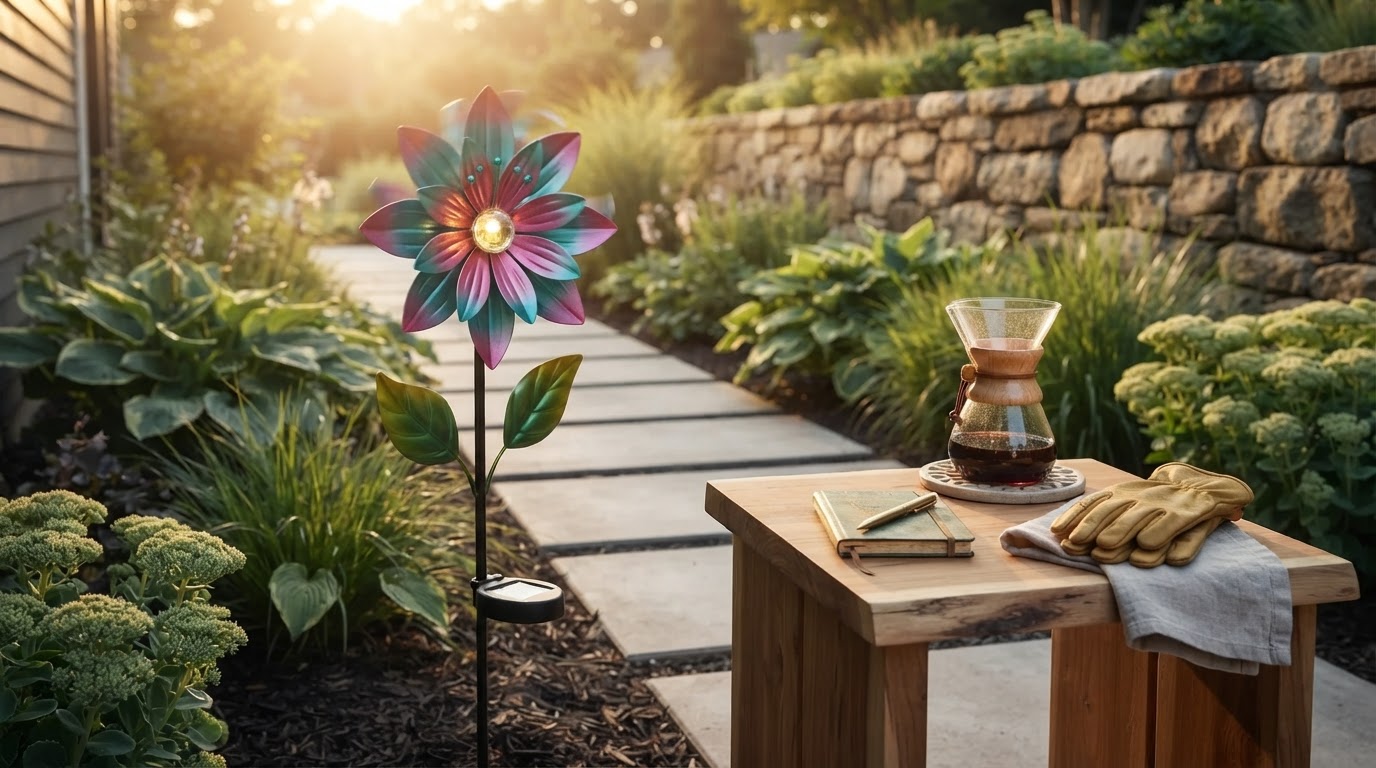
Solar Windmill Stakes address these mechanical failures by prioritizing the physics of rotation alongside energy storage. Unlike standard light up yard windmills that use thin gauge tin, these units are constructed from heavier metal alloys designed to maintain momentum once the air reaches a threshold velocity. Run the math: a heavier blade assembly requires more initial force to move, but it provides a smoother, more consistent rotation that reduces wear on the internal bearings. This stability is critical for the integrated solar components. In many light up yard windmills, the solar panel is a secondary thought, often shaded by the blades themselves. Solar Windmill Stakes utilize a top-mounted or offset photovoltaic cell that ensures maximum solar intake even during the winter months when the sun's angle is lower. This energy is stored in high-capacity batteries that power the internal LEDs for up to eight hours. By combining solar powered decorative windmills with a heavy-duty ground anchoring system, the product avoids the common 'lean' associated with top-heavy garden ornaments. The result is a piece of unique outdoor patio lighting ideas that functions as both a daytime kinetic sculpture and a nighttime navigational aid. The dual-rotor design seen in high-end models allows for bi-directional movement, which captures wind from multiple angles, a feature often missing in cheaper, single-plane spinners. This mechanical efficiency ensures that the lighting remains consistent because the battery is not being drained by a motor; the wind provides the motion, and the sun provides the light.
Evaluating Durability and Light Performance
Selecting a solar kinetic spinner requires moving past the visual appeal and looking at the hardware specifications. Data from Plow & Hearth indicates that premium metal wind spinners, such as the Ombre Floral models, are priced higher—often around $139.95—because they utilize weather-resistant finishes and precision-engineered rotors. When evaluating a potential purchase, consider the following technical checklist:
- Bearing Type: Sealed ball bearings are mandatory to prevent rust and grit infiltration that stops rotation.
- Metal Gauge: The blades must be thick enough to resist bending in 30mph winds but light enough to spin in a 5mph breeze.
- Battery Accessibility: Ensure the Ni-MH or Lithium-ion battery can be replaced, as all solar cells have a finite lifecycle.
- Stake Depth: A minimum of 8-12 inches of ground penetration is required to prevent the unit from toppling in saturated soil.
- LED Lumens: The light source should provide enough contrast to be visible from at least 20 feet without causing glare.
Shop Solar Windmill Stakes here.
Sources