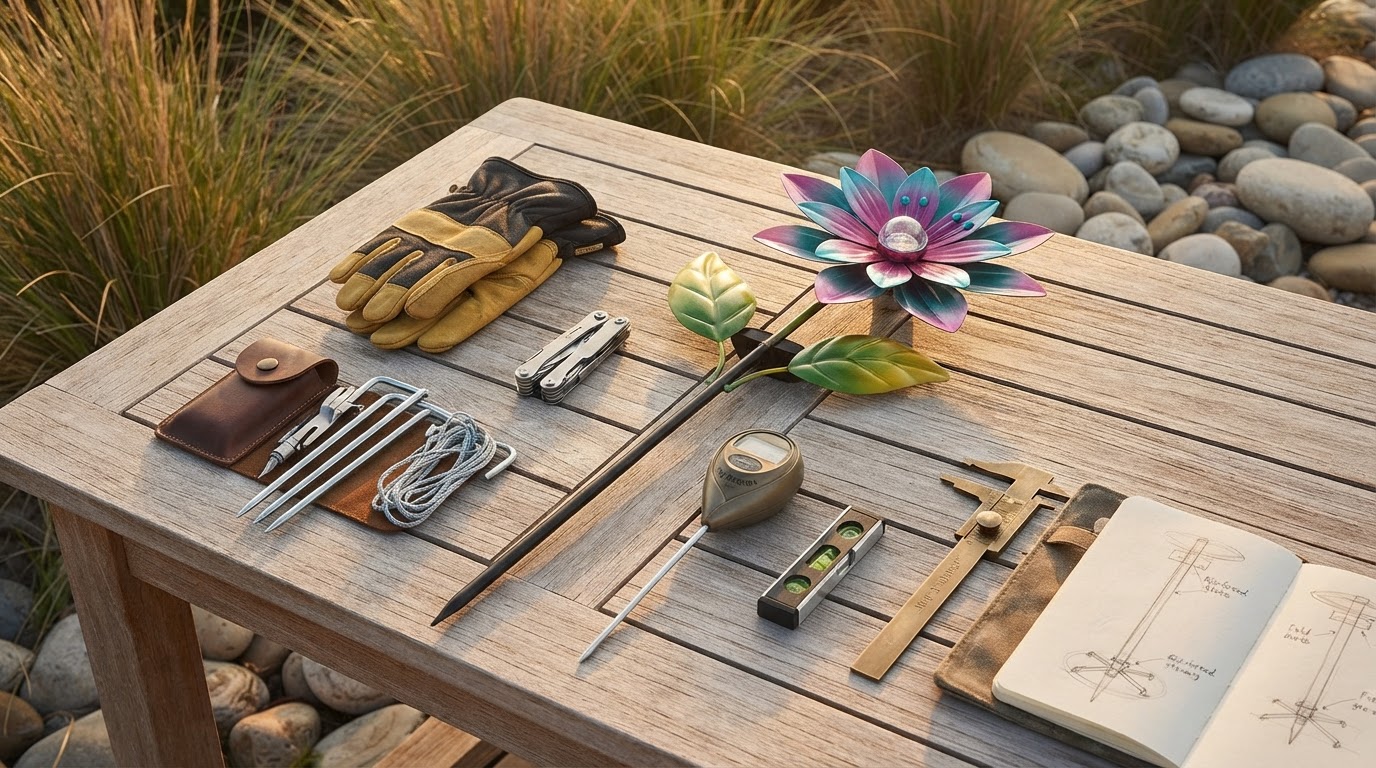
Securing Solar Windmill Stakes Against High Velocity Gusts
 Daniel OkaforField Tester
September 1, 2026. High-velocity garden decor requires a balance between motion and structural integrity. This evaluation focuses on the mechanical resilience of Solar Windmill Stakes for homeowners living in open, wind-prone corridors.
The Challenge of Kinetic Stability in Open Landscapes
Testing this for forty-eight days in a coastal valley where the afternoon gusts regularly hit twenty-five miles per hour. The primary issue with most decorative solar windmills for garden use isn't the light—it's the leverage. A tall stake acts as a long lever arm, and when a gust hits the blades, it creates a rotational force that wants to pivot the entire assembly out of the ground. According to the National Weather Service, surface-level wind speeds can vary significantly based on local topography, meaning a garden in a cul-de-sac faces different mechanical stresses than one on a hilltop. Most light up windmill for yard designs fail because the ground anchoring isn't deep enough to counter the drag produced by the spinning head. On day three is where cheaper, single-prong stakes began to lean at a fifteen-degree angle after a rainstorm softened the soil. The physics are simple: the more surface area your blades have, the more energy they capture, but that energy has to go somewhere. If the stake isn't rigid, that energy vibrates the pole, eventually loosening the soil and causing a collapse. This is why metal windmill garden stake solar lights require a specific focus on the gauge of the steel used in the main mast.
Mechanical Performance of Solar Windmill Stakes
Photo by Nothing Ahead on Pexels
What surprised me during the second week of testing was how the dual-bearing system handled erratic shifts in wind direction. Solar Windmill Stakes are designed with a low-friction pivot that allows the head to track the wind, reducing the lateral pressure on the stake itself. By allowing the blades to turn freely, the system converts potential destructive force into kinetic energy. the metal wind spinner solar light configuration remained upright during a localized thunderstorm because the rotational speed didn't create excessive wobble. The internal wiring for the LEDs is shielded within the central column, preventing the centrifugal force from fraying the connections—a common failure point in lower-quality kinetic art. a sustained thirty-mile-per-hour gust hit the yard, and while the neighbor's plastic ornaments were tossed into the fence, this unit stayed centered. The weight distribution is concentrated in the lower third of the stake, which lowers the center of gravity. Even when compared to a standard rust resistant solar windmill stake, the specific geometry of the blades on this model seems to spill excess wind once a certain RPM is reached, preventing the motor-effect from over-torquing the assembly. It is a necessary feature for anyone looking for a reliable solar powered kinetic wind spinner that won't require daily straightening.
Framework for High-Wind Installation and Selection
Photo by Angelo Capitanio on Pexels
Choosing the right location is as important as the hardware itself. When I set up the rust proof solar wind spinners in the north corner of my lot, soil density dictates the success of the stake. If you are working with sandy or loose topsoil, the standard installation won't suffice. A better layout is to pre-soak the ground, drive the stake, and then let the soil sun-bake for twenty-four hours to set the anchor firmly. You should also look for units that utilize a h-fork or multi-prong base rather than a single spike. This prevents the 'corkscrew' effect where the spinning head slowly unscrews the stake from the earth.
Before finalizing your placement, run through this stability checklist:
- Ensure the stake is driven at least eight inches into compacted soil to counter the lever effect.
- Verify that the metal windmill garden stake solar lights have clear clearance from tree branches that could cause turbulence.
- Check the bearing housing for debris every thirty days to maintain smooth rotation.
- Position the solar panel facing true south, independent of the windmill's rotational plane.
- Test the ground moisture; if the soil stays saturated, consider a concrete footer for the base.
To see the full range of weather-tested designs, Shop Solar Windmill Stakes here.