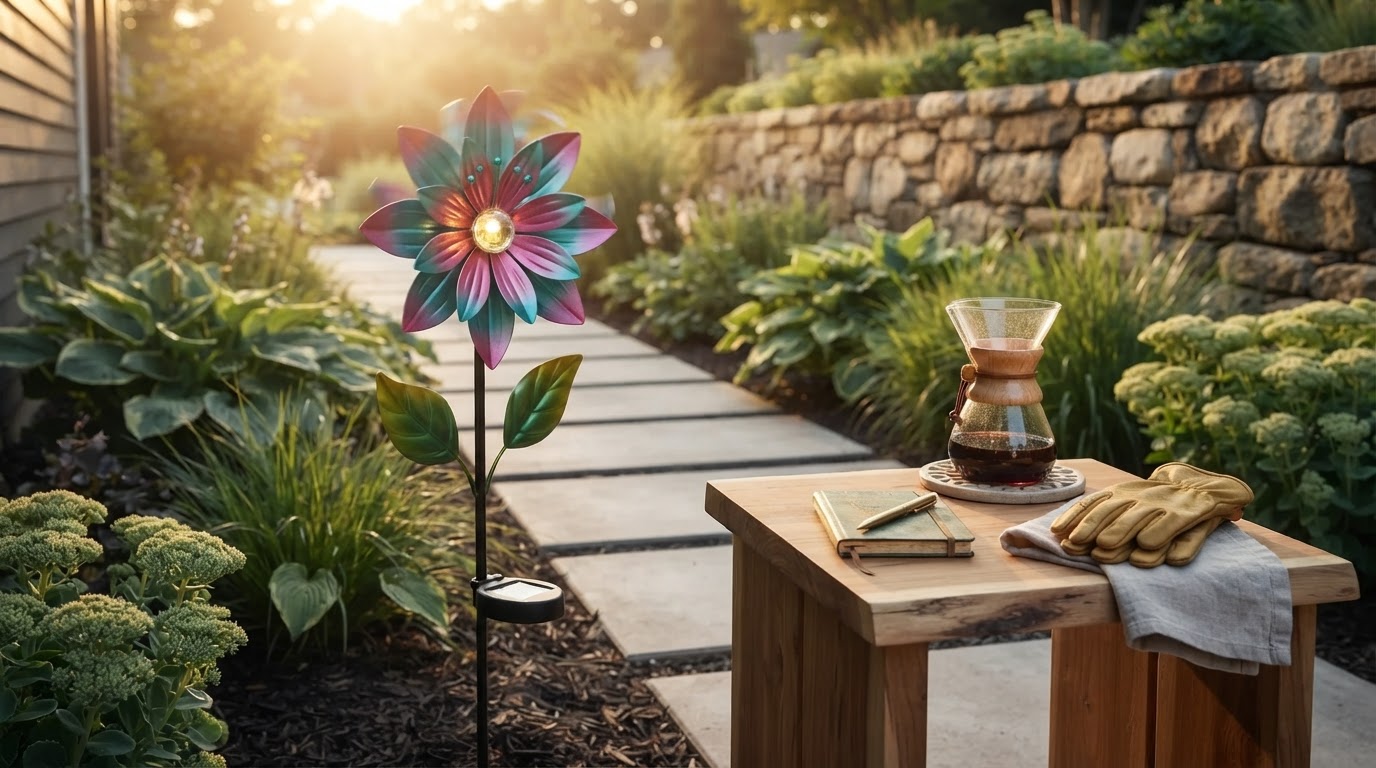
Integrating Solar Windmill Stakes into Modern Landscapes
 Maya ChenContributing Editor
October 11, 2026. This technical overview examines the functional requirements and aesthetic integration of solar windmill stakes for residential properties. It is intended for property owners seeking to balance kinetic motion with sustainable illumination.
The Limitations of Static Garden Decor
The conventional wisdom says that garden lighting should be discreet and stationary to avoid distracting from the natural landscape. However, static lighting often fails to provide visual interest during daylight hours, leading to a fragmented design language where the yard looks 'dead' until dusk. According to Alpine 4 U, kinetic stakes and windmills are specifically designed to add motion, dimension, and visual interest to outdoor spaces by catching the breeze, a utility that static bollard lights cannot replicate. Most consumers prioritize [outdoor solar wind spinners](/blog/outdoor-solar-wind-spinners) for their daytime presence, but the transition to nighttime visibility remains a significant pain point in traditional landscaping. The industry consensus suggests that motion is a distraction; I argue that without motion, a garden lacks the necessary dynamism to feel organic. Run the math: a standard solar light provides roughly 2-5 lumens of static output, whereas a windmill stake provides a shifting focal point that utilizes wind energy for movement and solar energy for light, doubling the utility of the occupied square footage. While some argue that mechanical components increase failure rates, the integration of [kinetic solar garden art](/blog/kinetic-solar-garden-art) has become a standard for those who reject the sterile look of fixed pathway lights. The reliance on purely decorative, non-functional ornaments is a design dead end that fails to leverage the environmental energy available in most open-air suburban lots.
Technical Integration of Solar Windmill Stakes
Solar Windmill Stakes address the gap between mechanical art and functional lighting by utilizing a dual-energy capture system. These units are typically constructed with metal vanes designed for low-torque startup, ensuring that even a light breeze initiates rotation. Here's the part nobody talks about: the efficiency of the solar charging cycle is heavily dependent on the clearance radius of the windmill blades. If the blades shadow the photovoltaic cell during peak sunlight hours, the battery will never reach full capacity. Solar Windmill Stakes are engineered to position the solar panel on the central shaft or a separate adjustable arm to mitigate this shadowing effect. This design allows for the consistent operation of internal LED modules, often housed within glass globes or integrated into the vane tips. Unlike standard solar powered wind spinners which may prioritize aesthetics over light duration, these stakes are optimized for a 6-to-8-hour discharge cycle. The hardware typically features a rustic or powder-coated finish to resist oxidation, a necessity for components that are constantly in motion. When evaluating these units, the focus must remain on the bearing quality; a high-friction bearing will render the 'windmill' portion of the stake useless in anything less than a gale. By combining the mechanical principles of outdoor solar wind spinners with modern battery chemistry, these stakes provide a reliable secondary light source that also serves as a wind-speed indicator for the homeowner. The integration of high-contrast materials, such as the bright glass details mentioned by Etsy sellers, ensures that the stake remains a visible architectural element even when the LED is inactive.
Selection and Placement Framework
Choosing the right kinetic hardware requires more than an aesthetic preference; it requires an assessment of the local wind microclimate and solar exposure. I'll change my mind when static lighting can provide the same level of pest deterrence and visual depth as a rotating blade assembly, but until then, the data supports kinetic installations. Before purchasing, run a site audit to ensure the intended location receives at least six hours of unobstructed sunlight. A common mistake is placing solar powered wind spinners under a tree canopy, which provides wind protection but kills the solar charging potential. For those looking for thematic consistency, specific models like the Solar Holiday Windmill Garden Stake Gnome described by LTD Commodities demonstrate how kinetic elements can be adapted for seasonal use without sacrificing the solar-powered core.
Use the following checklist to evaluate a potential installation site:
- Minimum 360-degree clearance of 24 inches to allow for blade rotation without obstruction.
- Soil density sufficient to support a stake height of up to 68 inches, as seen in the Alpine Patriotic Dual Kinetic models.
- South-facing orientation for the photovoltaic cell to maximize energy harvest.
- Proximity to low-lying foliage to create a contrast between natural and mechanical movement.
- Distance from high-intensity streetlights that might trigger the solar sensor to shut off prematurely.
- Verification of waterproof ratings (IP44 or higher) for the battery housing.
Shop Solar Windmill Stakes here.