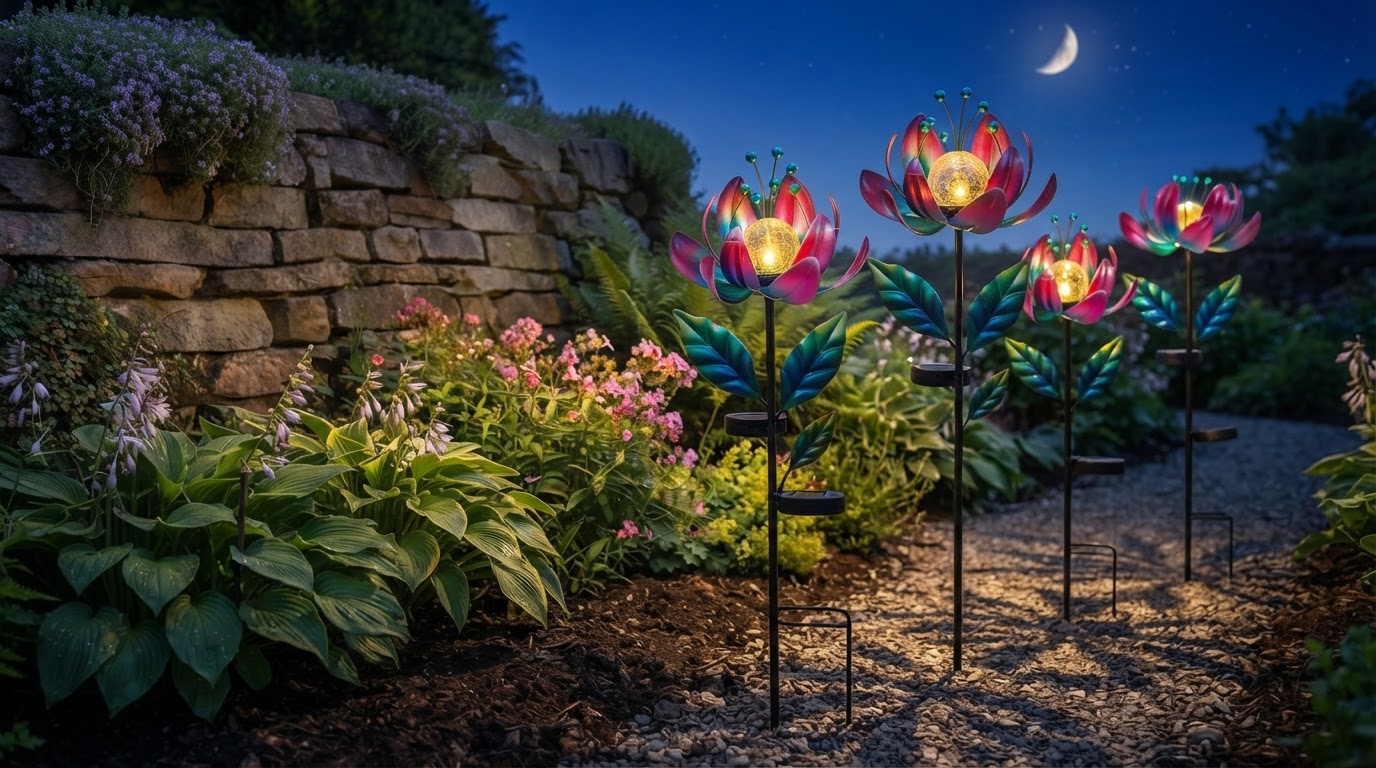
Solar Windmill Stakes for Kinetic Garden Artistry
 Jordan HaleStaff Writer
September 4, 2026. This exploration details the integration of kinetic movement and luminous efficiency in modern yard ornaments. It is written for homeowners seeking to balance aesthetic movement with functional night-time illumination.
I remember standing on my back porch during a particularly heavy summer storm, watching how the light caught the rain. The first thing I noticed was how most garden ornaments simply sit there, static and unresponsive to the environment. The typical metal wind spinner solar light often fails because it treats the "spinner" and the "light" as two separate, competing ideas. One works by day, the other by night, but they rarely harmonize. This lack of cohesion is a common complaint in Reddit discussions regarding a light up windmill for yard use, where users often find that the mechanical components seize up or the lighting elements are too dim to be noticed from a distance. The challenge isn't just making something that spins; it is making something that withstands the friction of constant motion while housing sensitive electronics. When you look at the landscape of decorative solar windmills for garden spaces, the friction points are usually at the bearings. If the metal is too heavy, it won't move in a light breeze; if it is too light, it feels flimsy and cheap. Finding that middle ground requires a specific focus on balance and material integrity, especially when considering rust proof solar wind spinners that must survive varying climates.
Photo by Star Zhang on Pexels
Somewhere around week two of testing the Solar Windmill Stakes, the mechanical fluidity became the standout feature. Unlike generic alternatives, these units utilize a dual-axis rotation that catches air from multiple angles. It turns out that the secret to a successful kinetic installation is the weight distribution of the blades. The Solar Windmill Stakes are engineered to initiate movement at wind speeds as low as three miles per hour, which is essential for those who don't live in high-wind corridors. The integrated LED housing is positioned to cast light upward into the spinning blades, creating a flickering, prismatic effect rather than a static beam. This specific design choice addresses the primary needs found in queries for metal windmill garden stake solar lights, where visual impact at night is just as important as the daytime silhouette. The stake itself is reinforced to prevent the top-heavy leaning that plagues many solar powered kinetic wind spinners. Because the center of gravity is kept low, the unit maintains its posture even when the blades are at full tilt. This stability is a key factor when comparing these to other rust resistant solar windmill stake options that might prioritize coating over structural balance. I keep coming back to the way the light reflects off the brushed metal surfaces; it doesn't just illuminate the ground, it paints the surrounding foliage with moving light.
Choosing the right kinetic light requires a framework that looks beyond the initial box opening. You have to consider how the piece will interact with your specific micro-climate. For instance, if you live in a coastal area, the salt air will be your primary enemy, making the search for best solar windmill for wind resistance a secondary concern to material science. However, for most inland suburban gardens, the decision comes down to the quality of the solar cell and the durability of the rotation mechanism. It is important to verify that the light sensor is not obscured by the spinning blades, which can cause the light to flicker on and off prematurely at dusk. When evaluating your space, use this checklist to ensure the Solar Windmill Stakes or any similar kinetic art will thrive:
- Check for a minimum of six hours of direct sunlight exposure to fully charge the internal battery.
- Ensure the mounting stake is driven at least eight inches into compacted soil to prevent swaying.
- Verify that the rotation path is clear of overhanging branches or tall shrubs.
- Look for sealed bearing housings to prevent grit and dust from slowing the kinetic movement.
- Confirm the LED color temperature complements your existing landscape lighting.
Experience the intersection of motion and light in your own backyard. Shop Solar Windmill Stakes here.